2.9 Aggregated Significance
Under Rule
3-05, the financial statements of acquirees that do not exceed the 20 percent
significance level are not required. However, when filing a registration or proxy
statement, a registrant must evaluate the aggregate significance of the following
categories:
- Category 1 — Probable acquisitions that do not exceed 50 percent.
- Category 2 — Consummated acquisitions that exceed 20 percent but do not exceed 50 percent and whose financial statements have not been filed (i.e., within the 75-day grace period; see Section 2.4.2.1.1).
- Category 3 — Any acquisitions consummated since the end of the registrant’s most recently completed fiscal year presented that do not exceed 20 percent.
If the aggregate significance of the acquirees in all three
categories above exceeds 50 percent, the registration or proxy statement must
include:
- The audited preacquisition financial statements for the most recent fiscal year and interim period for any acquirees in categories 1 and 2 above that exceed 20 percent significance and have not yet been filed.
- Pro forma financial information to reflect the aggregate effects of all acquirees in categories 1, 2, and 3.
Connecting the Dots
Although a registrant is only required to provide separate
financial statements for certain acquirees subject to the aggregate
significance evaluation, it must still obtain sufficient historical
financial information about all such acquirees to prepare the required pro
forma financial information when aggregate significance exceeds 50
percent.
The table below illustrates these
requirements, which refer to categories 1 through 3 (as defined above) and note that
a registrant must combine the categories of acquired or to be acquired businesses.
For fields marked “Required,” a registrant must provide separate financial
statements in a registration or proxy statement for that acquiree because it is individually significant. Therefore, a registrant is not
required to include such acquirees when determining the aggregate significance. When
evaluating acquisitions, if two or more of the acquirees are related businesses, the
registrant must apply the guidance in Section 2.7 before applying the guidance in
this section. See paragraph 2945.1
of the FRM.
|
Significance
|
Business Acquisition Completed 75 Days or
More Before Filing Registration/Proxy Statement
|
Business Acquisition Completed Less Than 75
Days Before Filing Registration/Proxy Statement
|
Probable Acquisition
|
|---|---|---|---|
|
Does not exceed 20 percent
|
Category 3
|
Category 3
|
Category 1
|
|
Exceeds 20 percent but not 50 percent
|
Required
|
Category 2
|
Category 1
|
|
Exceeds 50 percent
|
Required
|
Required
|
Required
|
2.9.1 Filings for Which the Financial Statements of Acquirees Subject to the Aggregation Evaluation Are Required
The requirement to provide financial statements under the aggregate significance
rules applies only to registration and proxy statements, as stated in
paragraph 2945.2 of the
FRM. With respect to delayed or continuous offerings (e.g., an effective shelf
registration statement — see Securities Act Rule 415), a registrant should also consider
whether any acquisitions occurring after the effective date of the registration
statement, when combined with previously aggregated acquirees before the
effective date, may be of such significance, in the aggregate, that an amendment
is necessary (i.e., the acquisitions represent a fundamental change). See
Section 2.4.3
for further discussion.
In a Form S-4, a registrant that has included the financial
statements of a target company does not need to include that target company when
applying the aggregation guidance in this section since the Form S-4 filing
already contains the target company’s financial statements (see Section 2.4.4 for a
discussion of the financial statement requirements for a target company in a
Form S-4 filing). However, the registrant would still need to comply with
Rule 3-05 for
any other acquirees (i.e., those that are unrelated to the target company)
subject to the aggregate significance evaluation.
Financial statements of acquirees subject to the aggregate
significance evaluation are not required in a Form 8-K. However, a registrant
may voluntarily provide the financial statements of these acquirees in a Form
8-K if it expects to incorporate them by reference into a future registration or
proxy statement. In certain acquisitions of related businesses, a Form 8-K may
be required. See Section
2.7 for further discussion.
As discussed in the note to paragraph 2945.1 of the FRM, an
entity cannot circumvent the aggregate disclosure requirements by voluntarily
filing financial statements for consummated Category 1 and Category 3
acquisitions and then testing the aggregate significance of the remaining
acquisitions that are within the scope of the requirement. For example, consider
a registrant that has consummated two acquisitions in the current year. Acquiree
A is 16 percent significant and, thus, is not individually significant. Acquiree
B is 35 percent significant and will be required to file financial statements,
but the financial statements have not yet been filed because the acquisition was
completed less than 74 days ago and, thus, is still within the grace period.
Together, on the basis of the aggregate significance evaluation, the
acquisitions are 51 percent significant and would require (1) audited financial
statements of B and (2) Article 11 pro forma information, including that of A
and B, within the registration statement. Voluntarily filing A’s financial
statements would not remove A from the group of acquirees subject to the
aggregate significance evaluation. However, as a Category 2 acquiree, the
registrant may file B’s financial statements in a Form 8-K during the grace
period, which would enable the registrant to exclude B from the aggregate
significance evaluation.
2.9.2 Period Over Which a Registrant Must Evaluate Aggregate Significance
A registrant must aggregate the financial information of any
acquirees subject to the aggregate significance evaluation after the date of the
registrant’s latest audited annual balance sheet filed with the SEC through the
effective date of the registration statement or the mailing date of the proxy
statement (see paragraph 2945.3
of the FRM). As a result, the filing could include consummated and probable
acquisitions over more than a 12-month period, as illustrated in the examples
below.
Example 2-35
Registrant A consummated the following
acquisitions:
- Company B on March 18, 20X3.
- Company C on August 12, 20X3.
- Company D on December 21, 20X3.
- Company E on January 10, 20X4.
- Company F on February 4, 20X4.
All six entities have a December 31
fiscal year-end, and B, C, D, E, and F are not related
businesses. In addition, the acquisitions of B, C, D, E,
and F did not exceed 20 percent significance on an
individual basis.
Registrant A plans to file a
registration statement on February 10, 20X4. The most
recent audited annual financial
statements filed with the SEC for A as of February 10,
20X4, are for the year ended December 31, 20X2.
Given these facts, A must aggregate the
financial information of B, C, D, E, and F when
performing the income, asset, and investment tests.
Example 2-36
Assume the same facts as in the previous
example, except Registrant A plans to file a
registration statement on April 23, 20X4.
The most recent audited annual financial statements filed with
the SEC for A as of April 23, 20X4, are for the year
ended December 31, 20X3.
Given the facts in this example, A must
aggregate the financial information of only Companies E
and F when performing the income, asset, and investment
tests.
Note that in both examples, A must also
include in the significance tests any additional
businesses acquired or to be acquired (that are within
the scope of the aggregate significance rules) after the
date the registration statement is initially filed
through the effective date or mailing date of the
registration or proxy statement, respectively.
2.9.3 Financial Statements Used to Measure Aggregate Significance
A registrant must perform the aggregate significance tests when
it files a registration or proxy statement and must use the most recent
preacquisition annual financial statements required as of
the filing date.
Note that these financial statements may not be the same as
those used in the calculation of individual significance performed as of
the date of each acquisition. That is, at the time the registration or proxy
statement is filed with the SEC, the registrant must use the more recent
financial statements when recalculating significance if (1) the registrant or
acquirees subject to the aggregation evaluation have filed more recent annual
financial statements than those used to determine individual significance or
(2) the registrant’s financial statements for the same fiscal year have been
retrospectively adjusted (e.g., a change in accounting principle or a
discontinued operation; see paragraph
2945.3 of the FRM). Such a recalculation could result in a
higher or lower level of significance than the amount calculated when the
acquisition was consummated.
As discussed in note 1 to paragraph 2945.3 of the FRM, this recalculation does
not change an existing registrant’s initial individual significance conclusion
at the time of the acquisition. An existing registrant is required to use the
updated significance amount in its aggregate significance test. However, if the
updated significance of an individual acquiree subsequently exceeds 20 percent
as a result of the recalculation, the existing registrant is not required to
file financial statements of the individual acquiree. Note that as discussed in
note 1 to paragraph 2945.3 of the FRM, if the registration statement is for an
IPO by a company that is not already a reporting company, updating the
assessment of individual significance as of the effective date is required.
Further, as discussed in note 2 to paragraph 2945.3 of the FRM, if the registrant
elects to reassess significance in connection with the registration statement by
using either “financial statements for a more recent annual period [or]
financial statements that were retrospectively adjusted giving effect to a
discontinued operation or change in accounting principle,” the results of the
reassessed significance must be used in its aggregate significance testing.
The same concept applies as of the date of
effectiveness of a registration statement or the mailing of a proxy statement. That is, at the time the registration
statement is declared effective or the proxy statement is mailed, if the
registrant or the acquirees within the scope of the aggregate significance rules
have filed more recent annual financial statements than those required to be
filed as of the filing date of the registration or proxy
statement, the registrant must use the more recent financial statements when
recalculating significance.
Example 2-37
Registrant A consummated the
acquisitions of Companies B and C, which are not related
businesses, during 20X4 on the dates shown in the table
below. The fiscal year-end of the three entities is
December 31.
Registrant A is a large accelerated
filer that filed its December 31, 20X3, Form 10-K when
due (March 1, 20X4). Further, the acquisitions of B and
C were not individually significant, and A intends to
file a registration statement on December 1, 20X4.
The acquisition dates and the level of
significance determined when each acquiree was tested
for significance individually, as well as the financial
statements used to calculate the individual
significance, are as follows: 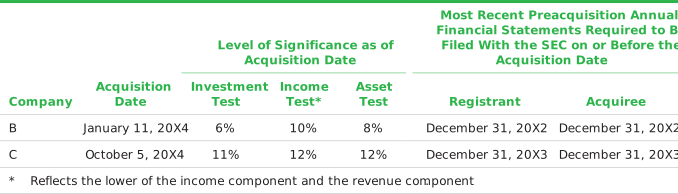
To calculate the aggregate significance
of B and C when preparing the December 1, 20X4,
registration statement, A must use B’s and C’s
preacquisition financial statements for the same fiscal
year as A’s (i.e., the most recent preacquisition annual
financial statements required to be filed with the SEC
as of December 1, 20X4). That is, A must use the
December 31, 20X3, financial statements for A, B, and C
when calculating the aggregate significance of B and
C.
The financial statements used in the
calculation of the aggregate significance for the
December 1, 20X4, registration statement are different
from those used to calculate the individual significance
of B as of the acquisition date. Accordingly, the level
of significance may be higher or lower than the amount
calculated as of the acquisition date. Registrant A must
comply with the above guidance through the effective
date of the registration statement.
Connecting the Dots
As noted above, if an existing registrant determining
the requirements for Form 8-K, Items 2.01 and 9.01, appropriately
concludes that audited financial statements are not required because the
acquiree is individually insignificant, no audited financial statements
of the individually insignificant acquiree will be required in any
future registration statements. However, the registrant should be aware
that information of the individually insignificant acquiree may be
required for Article 11 pro forma information if additional consummated
or probable acquisitions require the registrant to perform the aggregate
significance tests, and aggregate significance exceeds 50 percent.
Therefore, when evaluating the requirements for an acquiree, a
registrant should also consider its strategic plans for any potential
future acquisitions. This is particularly important when a new
registration statement is filed and the registrant or the individually
insignificant acquiree is required to use more recent annual financial
statements than those used to determine individual significance.
Planning for such events will help avoid a circumstance in which a
registrant is unable to secure the required acquiree financial
information long after the acquisition is consummated.
2.9.4 Performing the Tests of Aggregate Significance
To determine the significance of acquirees subject to the
aggregate significance evaluation, a registrant must perform the investment,
income, and asset tests in the aggregate (see Section 2.3 for a discussion of the
significance tests). When performing the asset test in the aggregate, the
registrant uses the total (combined) assets of the individually insignificant
acquirees. Additional considerations apply to the aggregate investment and
income tests, as discussed in the sections below.
2.9.4.1 Aggregate Significance — Investment Test
The investment test should be performed for each acquiree,
and the sum of each test should be used to evaluate aggregate significance.
If the acquisitions have different announcement or agreement dates, a
different AWMV may need to be used for each of them. In addition, the
registrant must include the aggregate impact of real estate acquirees (see
Section
3.3) when determining the aggregate significance. See Example 2-38.
2.9.4.2 Aggregate Significance — Income Test
In accordance with paragraph 2945.6 of the FRM, for both the income and
revenue components of the income test, a registrant should treat individual
acquirees subject to the aggregate significance evaluation as a single
business acquisition and use the aggregate pretax income or loss from
continuing operations and aggregate revenue for all such acquirees
(see Example
2-38). If either (1) the registrant reported a pretax loss
and the acquirees subject to the aggregate significance evaluation
all reported pretax income or (2) the registrant reported pretax
income and the acquirees subject to the aggregate significance evaluation
all reported a pretax loss, the registrant should use the
absolute value of such losses when performing the income test.
In addition, there may be situations in which one or more,
but not all, acquirees subject to the aggregate significance evaluation have
a loss in the most recent fiscal year used in the test. Rule 3-05(b)(2)(iv)
indicates that in such situations, acquirees “reporting losses must be
aggregated separately from those reporting income.” In accordance with
paragraph 2945.7 of the
FRM, when performing the income test, a registrant must separate the
acquirees into two groups: those that have pretax income (income group) and
those that have pretax losses (loss group). Absolute values of the pretax
loss of the loss group should not be aggregated with the pretax income of
the income group in the significance determination. Rather, a registrant
must use the (1) aggregated pretax income and aggregated revenue for the
income group when performing the income test for the income group and (2)
the aggregated absolute value of the pretax loss and aggregated revenue for
the loss group when performing the income test for the loss group. See
Example
2-39 and Example 2-40.
As discussed in paragraph
2945.7 of the FRM, the revenue component does not apply
if either the registrant or the acquirees did not have material revenue for
the two most recently completed fiscal years. In making this determination,
a registrant should consider the income and loss groups separately (i.e.,
assess materiality of revenues for the income group relative to the income
group and separately assess the materiality of revenues for the loss group
relative to the loss group). Accordingly, the revenue component may apply to
(1) both the income and loss groups, (2) neither the income group nor the
loss group, or (3) the income group only and not the loss group or vice
versa. If the revenue component does not apply to either group, a registrant
may be able to use its own five-year average of pretax income rather than
the amount for the most recently completed fiscal year to perform the
evaluation. See Section
2.3.4 for further discussion. If the revenue component
applies to either group, a registrant must consider both the income and
revenue components and would apply the disclosure requirements discussed in
this chapter only if it finds that the results of both components for a
single group (i.e., the income group or the loss group) exceed 50 percent
significance. If either the income group or the loss group exceeds 50
percent significance, the disclosure requirements discussed in this chapter
apply to all acquirees (i.e., both the income group
and the loss group). See Example 2-41.
In certain situations, as noted in paragraph 2945.8 of the FRM, it may be
appropriate for the registrant to use pro forma financial information filed
for a previous significant acquisition when performing the
significance tests for the acquirees subject to the aggregate significance
evaluation.. See Section
2.3.1.2 for additional information.
Example 2-38
Registrant A consummated the
acquisitions of Companies B, C, and D during 20X4 on
the dates shown in the table below. In addition, A
has determined that its acquisition of Company E is
probable (see Section
2.2) as of September 5, 20X4, and it
intends to file a registration statement on that
date. All five entities have a December 31 fiscal
year-end. The most recent preacquisition audited
annual financial statements required to be filed
with the SEC for A as of September 5, 20X4, are for
the year ended December 31, 20X3.
The acquisitions of B, C, and D were
not individually significant; however, the probable
acquisition of E is individually significant as of
September 5, 20X4 (i.e., it is between 20 and 50
percent significant). Registrant A has not yet filed
any preacquisition financial statements or pro forma
information.
Registrant A’s total assets as of
December 31, 20X3, were $100 million, and its pretax
income from continuing operations and revenue was
$15 million and $36 million, respectively, for the
year ended December 31, 20X3.
The following table summarizes the
acquisition dates and financial information of B, C,
D, and E as of and for the year ended December 31,
20X3, as well as the calculation of the aggregate
significance of B, C, D, and E:
To perform the significance tests, A
must aggregate the financial information of B, C, D,
and E.
The results of the significance
tests indicate that the highest aggregate
significance is 58 percent under the investment
test. Because the highest aggregate significance
exceeds 50 percent, A must provide financial
statements for acquirees whose results on any
significance test exceed 20 percent and for which
separate financial statements are not yet required
to be filed. Company E’s individual significance
under the investment test is greater than 20 percent
but less than 50 percent. Since the transaction is
probable and does not exceed 50 percent
significance, A would not yet be required to present
the financial statements of E on the basis of its individual significance
(unless they have been previously filed). However,
as described above, A has to include separate
financial statements of E in this registration
statement because it must provide the financial
statements for acquirees whose results on any
significance test exceed 20 percent and for which
separate financial statements are not yet required
to be filed. In addition, A must provide pro forma
information reflecting all
of the acquisitions described above.
Example 2-39
Registrant A consummated the
acquisitions of Companies B, C, D, E, F, and G,
which are not related businesses, during 20X4. The
acquisitions were not individually significant, all
seven entities have a December 31 year-end, and A
plans to file a registration statement on December
20, 20X4.
The most recent audited annual
financial statements required to be filed with the
SEC for A as of December 20, 20X4, are for the year
ended December 31, 20X3. Registrant A’s pretax
income from continuing operations and revenue was
$10 million and $40 million for the year ended
December 31, 20X3, respectively.
The significances calculated in the
aggregate investment test and aggregate asset test
were less than 50 percent. (Those calculations are
not included in this example.)
The following table summarizes the
pretax income (loss) from continuing operations and
revenue of all seven entities for the year ended
December 31, 20X3, as well as the aggregate income
test calculation for B, C, D, E, F, and G:
To perform the income test, A must
(1) separately combine the aggregate income from
continuing operations and revenue of the income
group (C, D, and F) and the pretax loss from
continuing operations and revenue of the loss group
(B, E, and G) and (2) use the absolute value of the
combined loss of B, E, and G.
As discussed above, a registrant
must consider both the income and revenue
components. Since both the income component (52
percent) and the revenue component (68 percent) of
the loss group exceed 50 percent, pro forma
financial information must be provided for all
acquirees subject to the aggregate significance
evaluation, including both acquirees with
pretax loss and those with pretax income (even
though only the loss group exceeded 50 percent
significance). Since none of the acquirees exceed 20
percent significance for any of the significance
tests, no separate preacquisition financial
statements are required.
Example 2-40
Assume the same facts as in the
previous example, except that Company E’s pretax
loss from continuing operations is $1.5 million.
This will reduce the aggregate significance of the
loss group to 49 percent on the basis of the income
component. While the revenue component of the loss
group exceeds 50 percent, the income component does
not. As a result, neither the income group nor the
loss group exceeds 50 percent significance for both the revenue and income
component. Therefore, the requirements for acquirees
subject to the aggregate significance evaluation
discussed in this section would not apply.
Example 2-41
Assume the same facts as in
Example 2-39, except that Registrant
A has no revenue in 20X3. Since A did not have
material revenue for the two most recently completed
fiscal years, the revenue component does not apply.
In this case, the registrant would only need to
consider the results from the income component
calculations. Assume that A’s pretax income from
continuing operations for the most recent fiscal
year is not at least 10 percent less than the
five-year average of such measure.
To perform the income component of
the income test, A must separately combine the
pretax income from continuing operations of the
income group (Companies C, D, and F) and the pretax
loss from continuing operations of the loss group
(Companies B, E, and G). Registrant A must use the
absolute value of the combined loss of B, E, and G
in the income component of the income test.
As discussed above, a registrant
must consider the income component of each group.
Since the income component (52 percent) of the loss
group exceeds 50 percent, pro forma financial
information must be provided for all individually
insignificant acquirees, including both acquirees with pretax
loss and those with pretax income (even though only
the loss group exceeded 50 percent significance).
Since none of the acquirees exceed 20 percent
significance for any of the significance tests, no
separate preacquisition financial statements are
required.